Trillium Time

I complain a lot about the heavy clay-loam that comprises most of the soil that I have to garden in. There are plenty of wonderful plants that I have given up on as residents in my garden. However I’ve come to embrace those species which thrive here and seed about happily.

One such group of plants (that of special interest to me) are the Trilliums. As long time member of the GLC (Great Lakes Chapter of NARGS), I have benefited greatly from the generosity and guidance of many of our legendary members, most of whom are only with us in the wonderful plants they shared, and I am grateful for this memorable connection.

Decades ago, the GLCs’ sales tables as well as the generosity garden friends, were the only means one had to acquire these special plants found in our gardens today. The greatest driving force in both the dispersal and how to grow trilliums, rests with a pair of our chapter’s founding members; Roberta & Fred Case. To be sure other members contributed as well, but year in and year out most all of the trillium to appear in our Plant Sales, trace their histories back to the Case’s Garden and many of those went into the plant Auction. The bidding was always lively and quickly ascended to a point well beyond my comfort level.

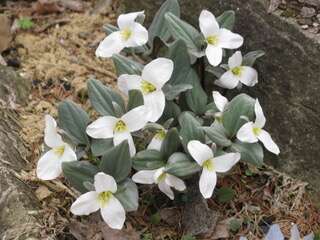
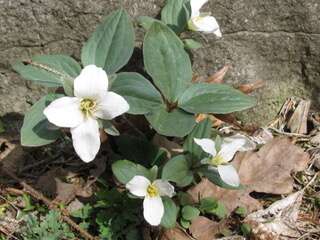
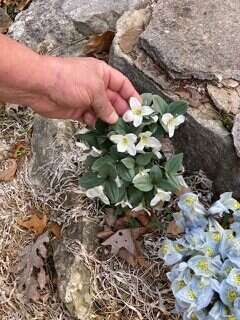
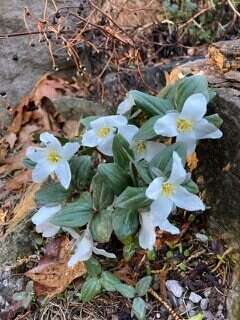
The first trillium to appear in our gardens is the Snow Trillium, T. nivale. which is always snapped up whenever a division appears on our Club’s sales tables.
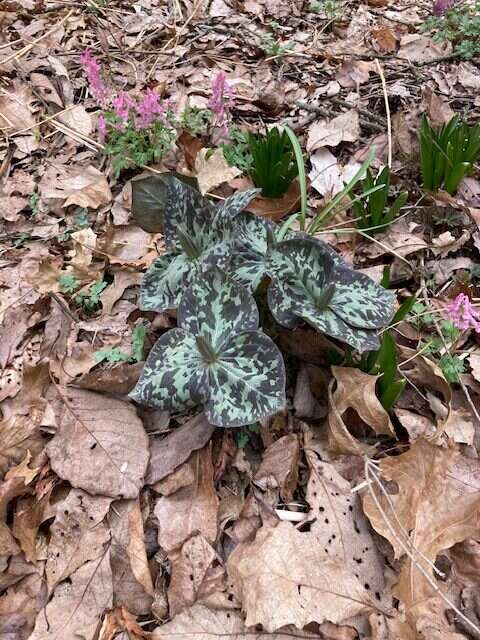
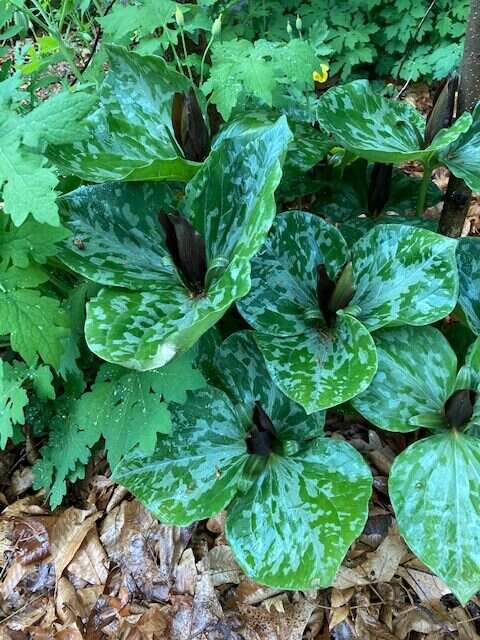
The first Case trillium that I was able to attain was T. cueneatum, a bit more subdued than many of the other show-stoppers that they had donated, but I was thrilled to have gotten them none the less.

With each passing year they and their progeny, have increased and improved, some becoming quite spectacular in their own right with near black flowers,
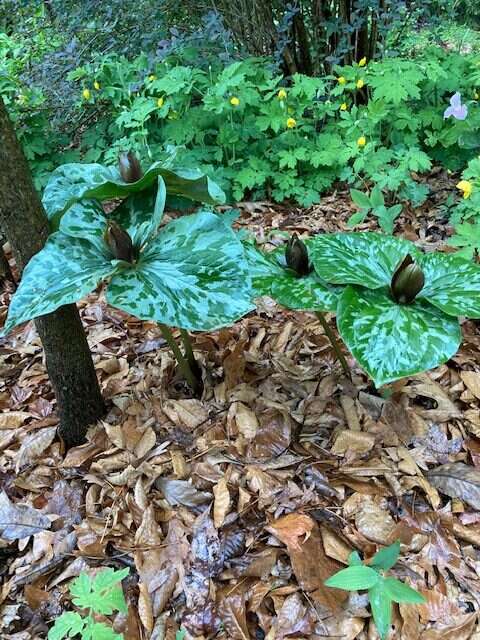
and massive size, these are 14 – 16″ in height!

But even before I had any success at the Sales my dear friend and mentor Dick Punnett, had shared countless numbers of the T. grandifloras that he considered near-weeds. So plentiful were these adaptable trillium, in the rich damp woods that made-up most of his one of a kind garden, that almost anytime he wanted to create a new bed he would first start by digging up a dozen or so and tossing them aside. I would gather them up, quick as I could or they’d die in the sun. They may have been weeds to him but they were nothing short of treasures to me. Better still the form that grew in his woods have a wonderful trait in that they quickly grew into sizable clumps.
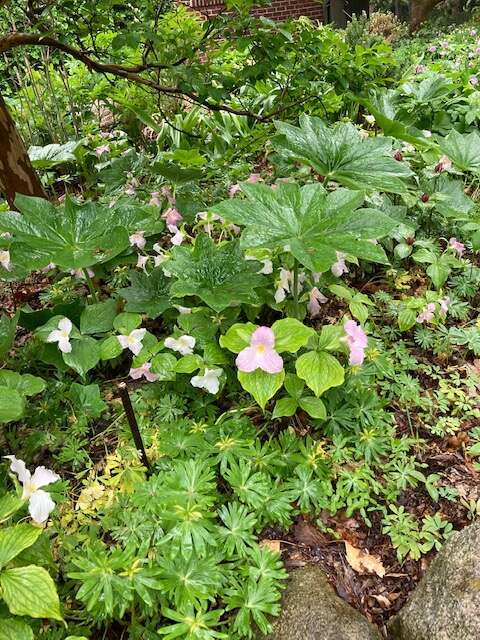
Today almost every woodland bed in our garden contains some of Dick’s Trillium grandifloras. They are the most plentiful trillium here, but I can’t bring myself to call them common.

Other members have contributed T. grandifloras as well to our clubs’ sales over the years, and I always took advantage of adding to the gene pool in the garden.
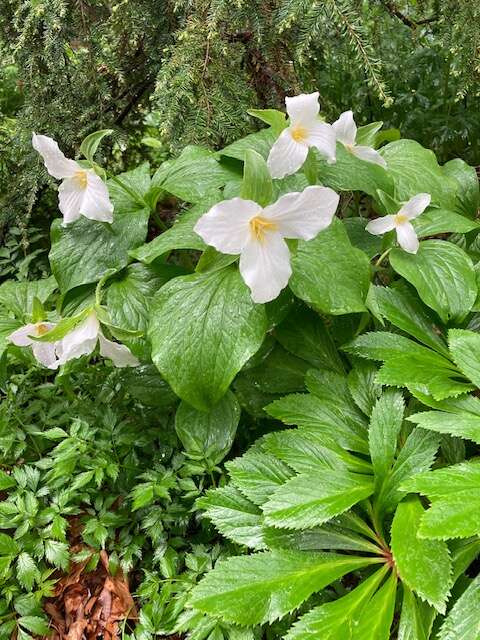
Whenever a local woodlot was about to be razed to make way for yet another sub-division, I would always make a quick search and if Trillium were present, a stop at the construction trailer to get permission to remove them was never refused.

A close second to T. grandiflora (in abundance in this garden), would have to be T. recurvatum. The prairie trillium is very happy to occupy sunnier edges of the woodland bed, even venturing out quite some distance into full sun.
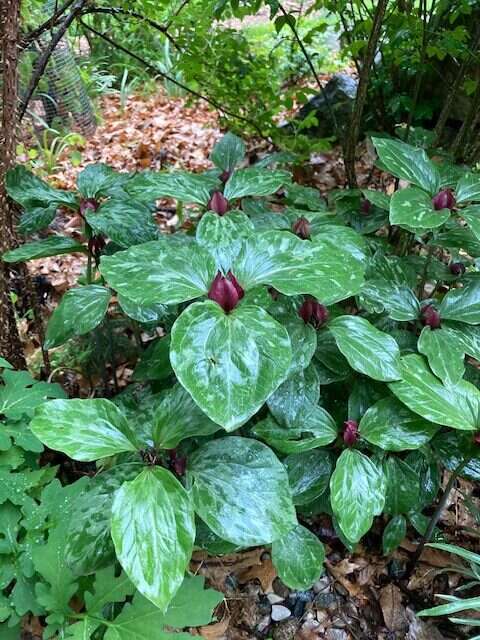
There are several forms of trillium recurvatum in the garden. One is stoloniferous and makes massive patches with alarming rapidity, but when you’ve started with acres of empty space this was a plus as I could easily add it here and there and let it do it’s thing.

Other forms were later purchased from nurseries such as Arrowhead Alpines or Plant Delights.
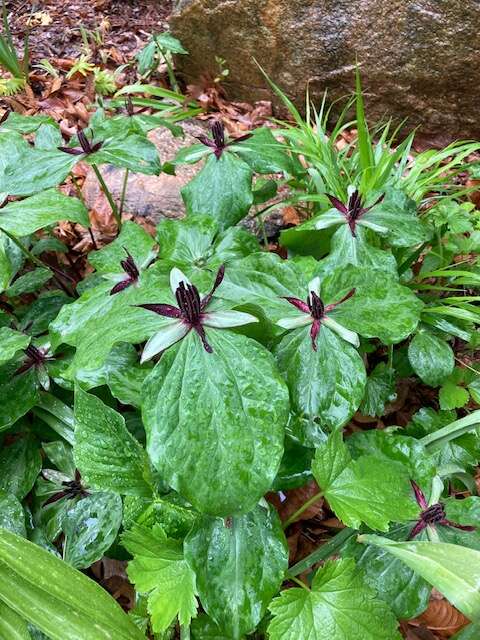
This is Trillium stamineum (another purchase from Arrowhead Alpines), it’s twisted petals distinguishes it from all other trillium. This spring I was surprised to find a single flowering stem over 200ft. away from what has become the original patch, the work of Yellow Jackets and wasps.
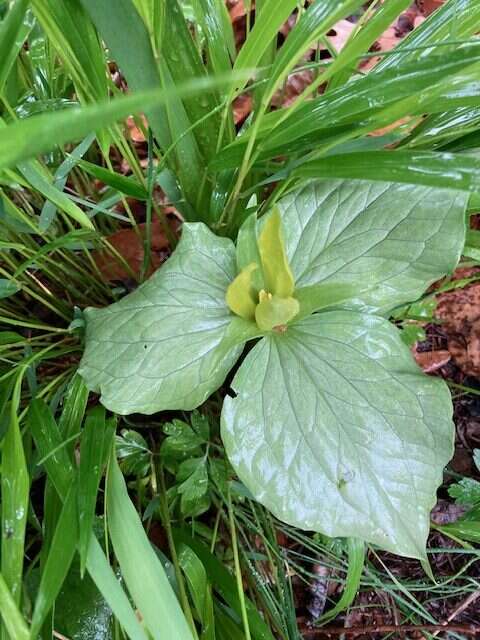
This plant remains a mystery to me. It was given to me by Bob Stewart on the day his shipment of trillium came in from a Southern wholesaler. Dick & I happened to be present the day the box arrived. When Bob opened the crate and there were three copies of a plant that looked very different from all of the others. Bob handed one of them to Dick, another to me and kept on for himself.

I planted mine in the garden and it made a clump of a dozen stems in short order. So I dug up and divided the clump, gave divisions to Don and Tony, and scattered the others through out the garden, but only 3 of my divisions survived the ordeal.

My first copy of the following trillium arrived via Southern acquaintance of Dicks, I remember his first name was Ewen but I cannot recall his last name.
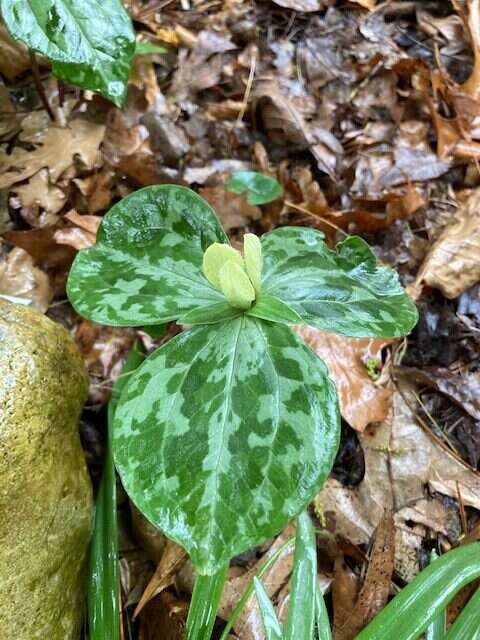
This little beauty is Trillium discolor. It had never set seed on its own so I’ve added several more courtesy of PDN.

These also came to be in our garden thanks to the folks at Plants Delight Nursery. Sadly the rain has muted its silvery sheen, and dulled its maroon blotches.

Trillium underwoodii according to the PDN, catalog hales from the dry Alabama woodlands, but has been a reliable performer here in my somewhat dry Michigan woodland bed. Which is more than I can say for T. decipiens, in three tries I have as yet to find a place to make that species happy.

Not too far away from the proceeding trillium, is a thriving clump of another mail-ordered trillium.
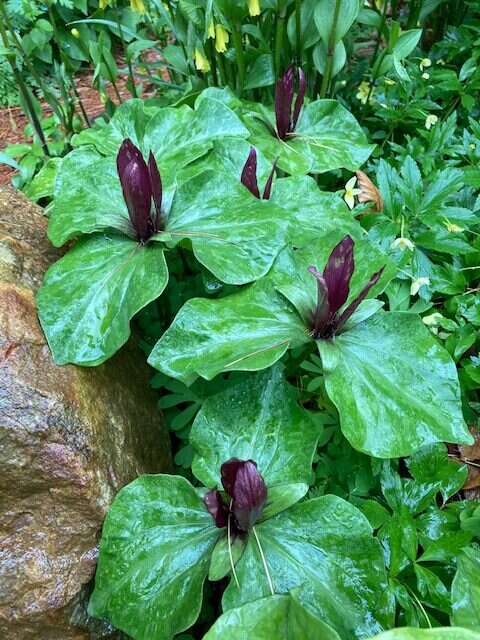
Trillium kurabayashii came to me via Janus Ruksan’s Nursery in Latvia, and has made itself right at home here in SE Michigan. I’ve even added a hybrid to my collection (from Far Reaches Farm), of this trillium and the following Trillium.

Trillium albidum arrived as gifts in an order from Natures Garden Nursery, a mail order nursery run by Frederick Held in Scio, Oregon. They have made the move East and slowly self sown seedlings appear here or there.

I can’t say the following Trillium sessile have seeded about…
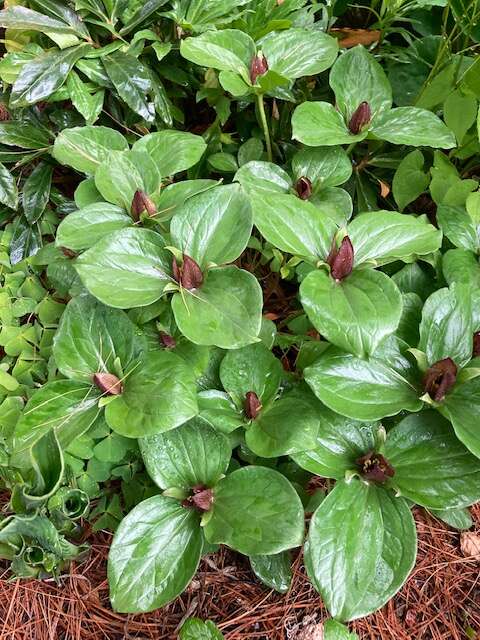
…the clumps of the forms I have seem amiable to division. There are at least 2 forms in the garden, one a GLC Sales purchase, the other a gift from Don La Fond.
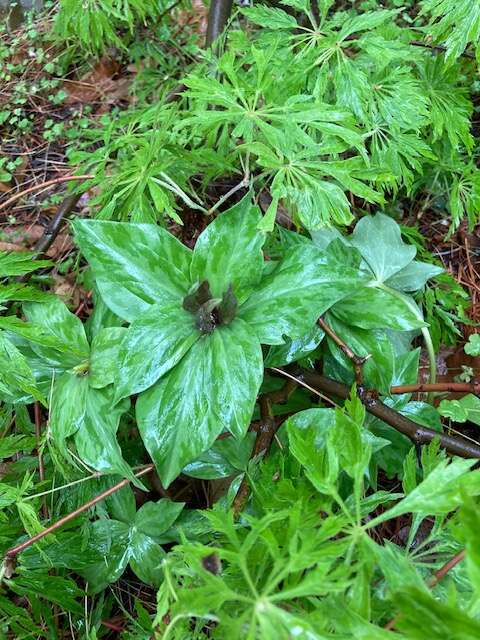
This unusual 6 leaved form of Trillium cuneatum arrived in the garden via a GLC Sales also. It was donated to the plant auction by Tony Reznicek, who acquired it from Ellen Horning’s ‘Senica Hill Nursery’.
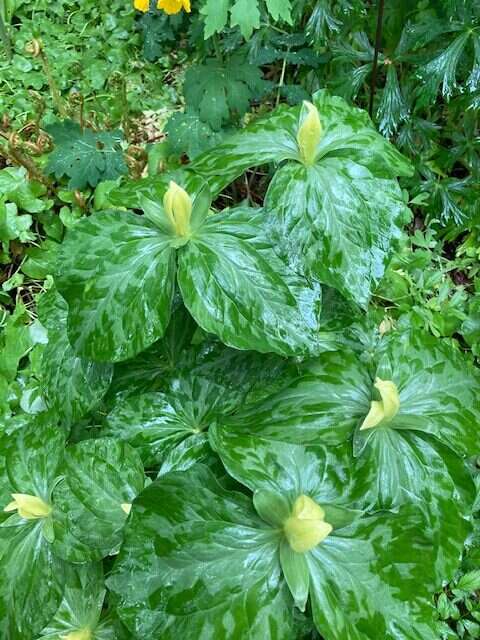
Another GLC Sales purchase (from long ago) was Trillium luteum. Very few seedlings have appear, however I believe the fault is mine, as these plants are located in an area with far too much, other plant competition for seedlings to survive.

I believe the trillium species with the third oldest longevity in our garden belongs to this cultivar of Trillium cernuum.
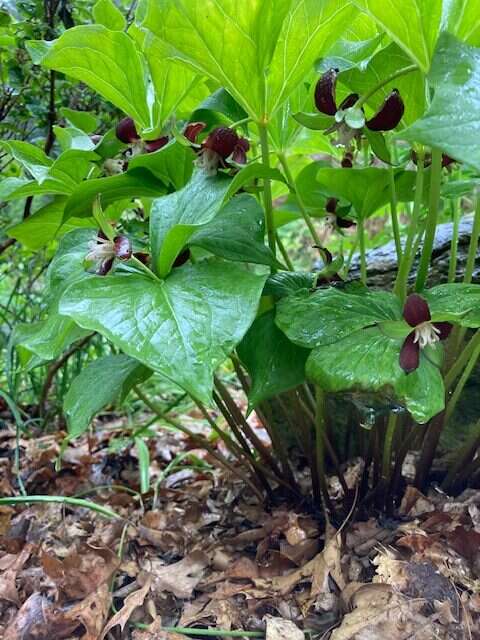
Decades ago Dick and I went to explore the long-ago, abandoned site of his garden mentor Bob Tucker. The property had been purchased by one of the Big Three Automobile Companies, but hadn’t fenced it in, nor razed the house or garden as yet. This was one of the few rescues from the Bull-dozer

A relatively, more recent purchase via a GLC auction, is this Trillium viridescens. The bidding was so intense between myself and another long-time GLC member (as well as a fellow fanatic of the genus, and dear soul to boot), I simply had to divide the clump to share it with her. I am really over-due in dividing this clump again.
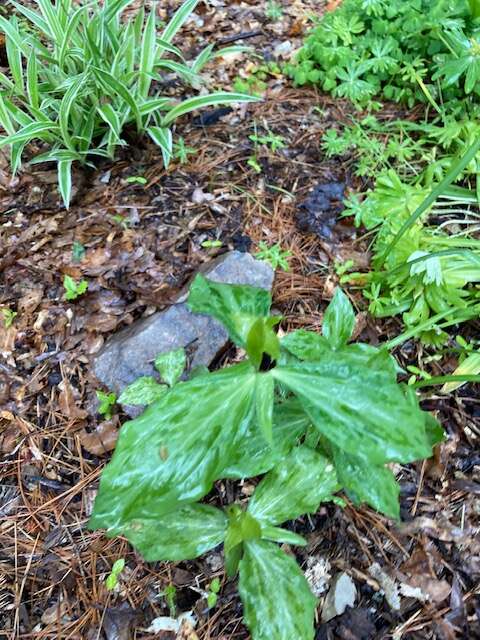
An even more recent addition is this expanding clump of Trillium oostingii, which came to me via fellow, long-time GLC member, Bob Swartz. It is the only one of the more recently-discovered, Southern species that I’ve succeeded in finding the correct placement for in the garden, on the first try.

Within the past decade, I have been one of the very fortunate recipients to have been handed a 1-gallon, plastic zip-lock bag-full, of trillium seed heads that were gathered from the Case’s Garden. There was no telling what they were, but they were sure to be good. I sowed the seed from each capsule into t’sown 4″x4″ pot, and by the third year the pots were chock-full of multiple plants needing to be planted out. Dozens of pot-fulls went into the garden and dozens went onto the GLC Sales tables.
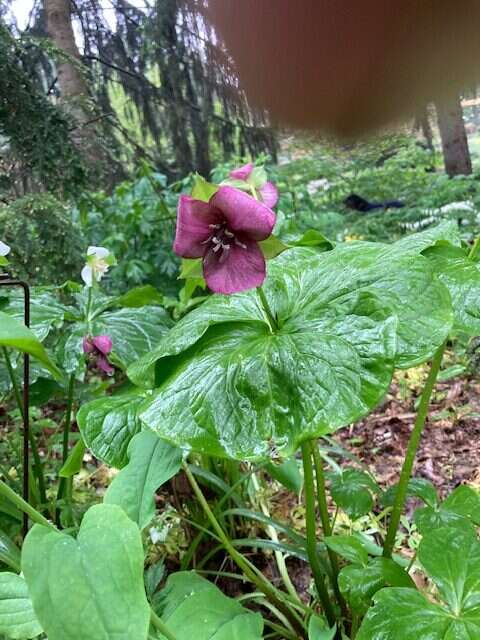
Trillium sulcatum?
Trillium flexipes (please excuse my finger).

Not only have those pots yielded wonderful species but many hybrids as well, most of which had flowered so early I failed to capture their images. This year there are a second round of mixed-Case- seedlings ready for a place in the garden.

As special and wonderful as all of these species and hybrids are, the trilliums which stop visitors in their tracks are the double-flowered forms of T. grandiflora.
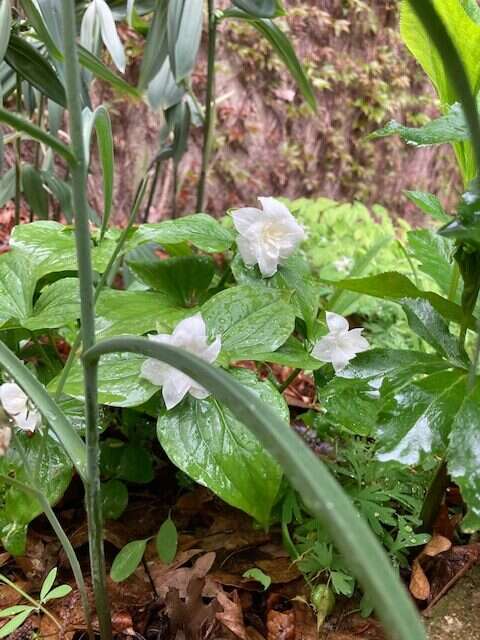
Some were gifts, one a rare plant auction win, others and perhaps my favorites were finds, while out roaming woodlots with very close friends.

All are quite unique.
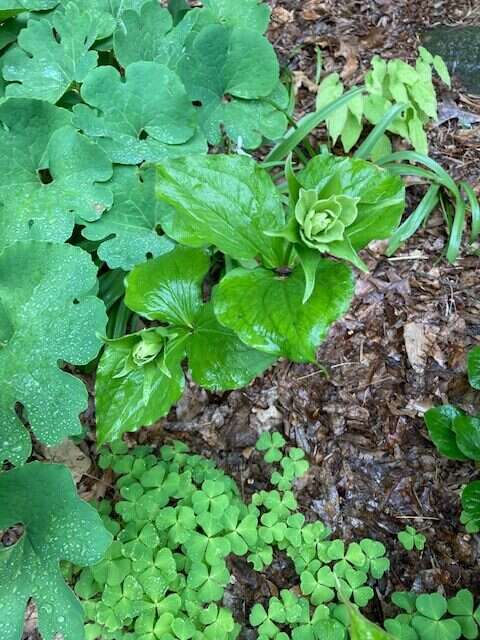
All of them need to be grown on, divided and shared.

In spite of my attempts, I have as yet failed in getting this green, single-flowered form to set seed.
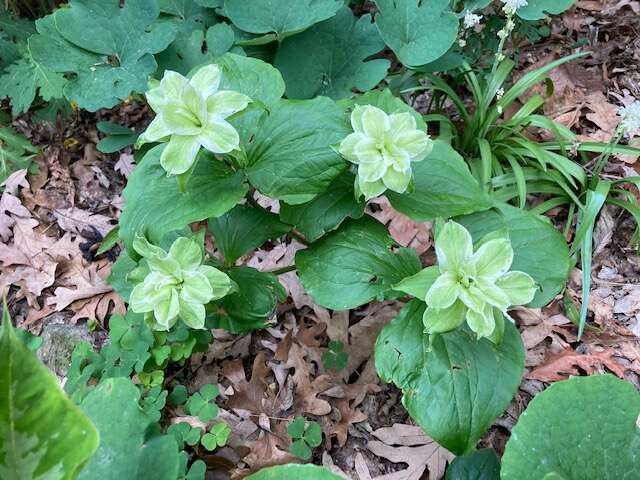
Hopefully in the not too far future, they will make it into the trade.

In creating this post, I’ve failed to include not only nearly all of the hybrids, but several species as well. However I feel confident this post illustrates how these wonderful and growable woodland plants are, and deserve a place in our gardens.

Are you Crazy?

First it was here, for 20 years slowly sadly sinking in the dirt. I secretly coveted it to rescue it every time I walked by it.
Then it was here.

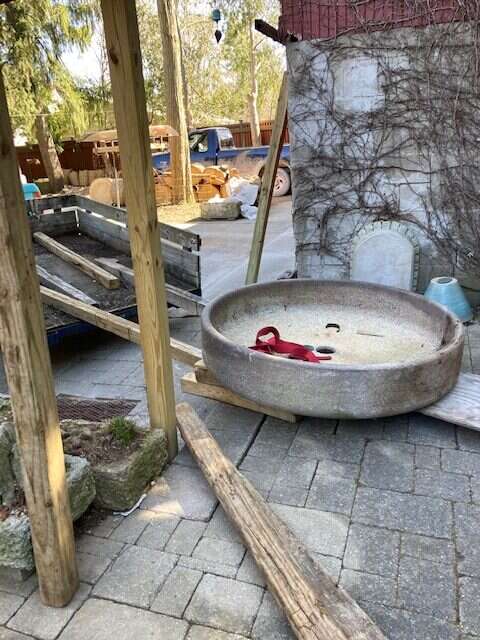
Why would someone not want to use this artifact in their garden? Yes it was heavy and yes it wouldn’t fit in the back of that beautiful K mart blue truck, so I had to go back and get my trailer.

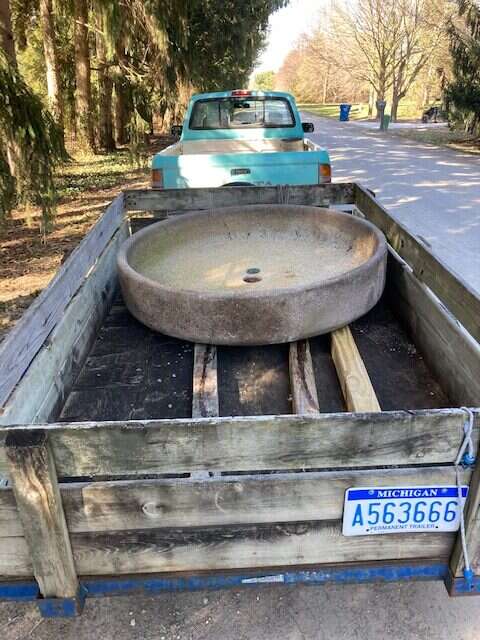
See, it fit. Yes it took two of us to load it and a gallon of dish soap for lubricant. And no we don’t need surgery

Yet

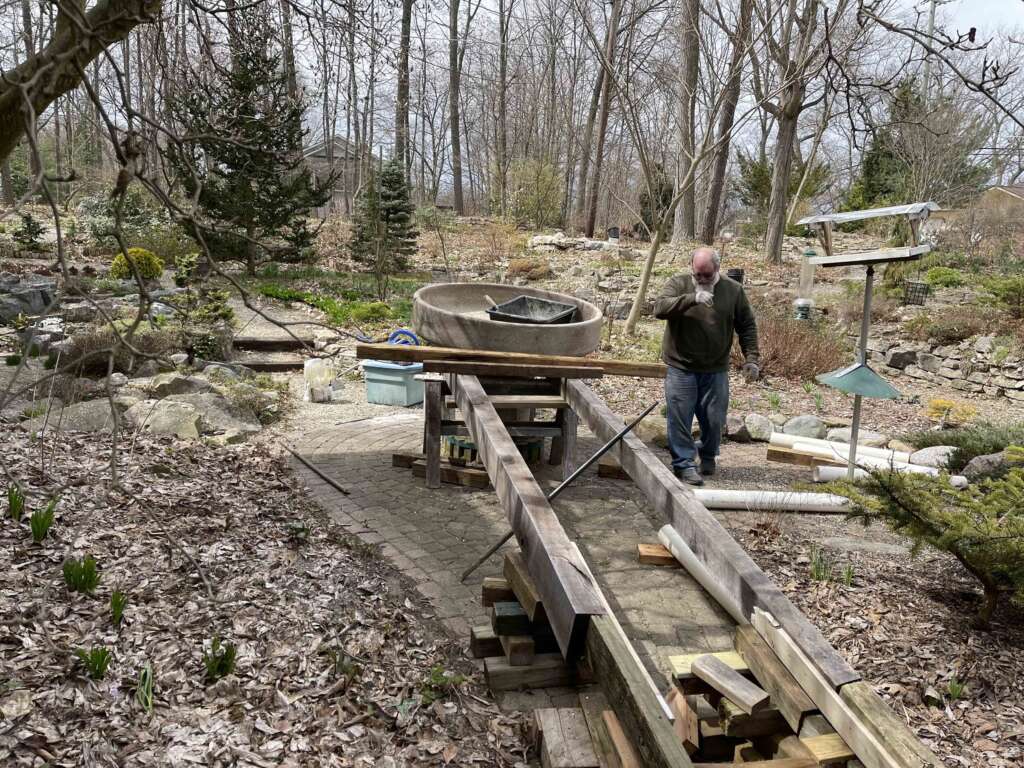
Taking a page from the Pyramid builders, I built a long ramp, and using rollers under the artifact- industrial sink, to roll on. It took only three men to roll it up the ramp successfully, and we still don’t need surgery.

Yet

I used a cement pipe as a pedestal.

Ain’t it cool daddy!

Thank you Jacques and Tony

Next what kind of rocks should I use?

This Is A Test

This is a test but you won’t have any questions to answer, better still Its just a trial run to see if I can still Post.

For the past two weeks things have progressed so quickly that there’s been little time to take pictures, let alone sit down, collect my thoughts enough to produce a post.

One of things that has gotten done is the transfer of a very large industrial sink (one of three) that was given to me along time ago by John Serowitz.

I had intended on snapping a Pic of of the Big “Sink of Shame” prior to moving it, here’s where it rested, slowly sinking into the ground for nearly 20 years.

I’d always thought of utilizing the sinks together as a fountain, or even 3 separate containerized gardens, but it never happened. During the past nearly 2 decades I never could picture these within any of the parts of the garden that I built. As the year’s passed, I’d given the two smaller sinks (30″ diameter by 10 ” deep), to Don, but held onto the big 54″ by 10″ sink (always hoping for some epiphany to come as to how I could incorporate it somewhere where it would fit esthetically in the garden.

But the years kept flying past and more and more of the garden areas were developed, without ever coming up with a place to site the BIG sink. Every time I walked past where it leaned against the back of the garage, I was shamed with guilt for wasting such as prize. Finally I couldn’t bear any longer and I told Don to come and take it away.

So on the appointed day, Don came by and we rolled the sink over to where we had planned to slide it up on timbers into the back of his truck, only to realize the truck bed was too narrow. Don had to go and get his trailer and come back.

It went up and onto the trailer much more easily than our first attempt, at loading it into the taller and narrower truck bed. Here it is loaded up and ready to travel to its new home.

Don will have to post part 2 of this story.

And We’re Off!

For several weeks I’ve been prowling about the garden, repeatedly scanning patches of ground where something should be showing up. All the while having to count on a handful of the earliest Spring Bulbs to satisfy my plant-lust. The up’s & down’s of SE Michigan’s transition from winter to spring is close to reaching the tipping point, brought on by just a couple of 70 + degree days.

The winter aconites & snowdrops, along with Cyclamen coum, Hellebore tibetanus, and Adonis, have thrilled and delighted for almost a Month now. Each opening flower pushes the winter-blahs further to the back of my mind, while stoking a near-burning desire to see what comes next. Gradually, the once brown, almost blanket-flat mulch of last years leaves, had started to bubble from the push of activity beneath, and now that activity has boiled into an eruption in a colorful blooms and vibrant foliage.

Corydalis solida’s and Iris reticulates have appeared almost everywhere in the garden.

Over the past decade, Corydalis solida seem especially determined to occupy every vacant space they can find. There are several other Corydalis species in bloom but none can match the nearly rabbit-like fecundity of C. solida.

Corydalis ornada has slowly and steadily, increased for us. Sadly we haven’t been successful in keeping any of the electric blues or rich, saturated rose-pinks.

For reasons unknown to me only the white flowered forms of C. ornate seem happy in various locations to the garden. It’s really a shame as this species (if you can keep them) come in some of the most spectacularly- saturated, colors that I have experienced within the genus.

Above is Corydalis x allenii ‘Gilded Beauty’ purchased from Janis Ruksans in April 2004. It has happily coexisted here along with an Anemone nemorosa and Ajuga ‘Metalica Crispa’. I don’t think one could ask for more of a plant, except maybe for more off-sets or seed!

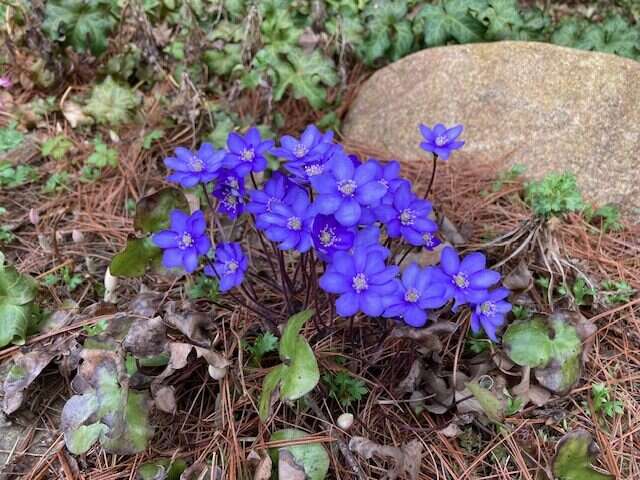
All across the garden Hepaticas are popping out.

Over the years we’ve amassed a number of good color forms.

Although they are not usually the earliest hepatica to bloom, I believe these (pictured above) are all H. nobilis. A species that in this garden are easy to please and happy to seed about.

H. acutiloba

Hepatica media is usually the first of the species to flower for me (but I failed to look for them).

This H. acutiloba has decided conditions are right to open now.

T. cuneatum
T. cuneatum

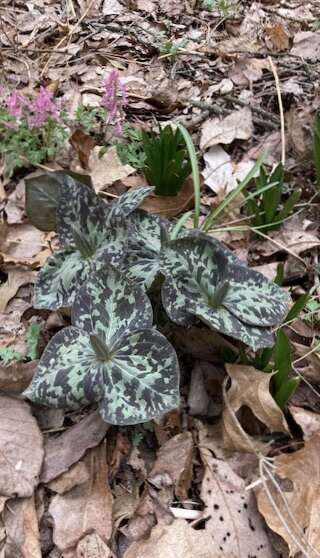
Several trillium species are up as well. The clay-loam soil that covers nearly all of the property (except for the alpine beds built on-top of it), seems to suit most all of the species that grow . After T. nivale, Trillium cuneatum will be the next to bloom. Although several other trillium species are up including T. recurvatum, T. sessile, and T. stamineum. No doubt. there are another half dozen species whose noses are just beneath the leaf litter, waiting a little longer.

T. recurvatum

Abeliophyllum distichum as it grows here, spreads slowly by lower branches rooting in where they contact the ground. The thousands of tiny white blossoms flood the lower garden with their sweet perfume.

This early flowering and frost-proof shrub is commonly referred to as White Forsythia.

Among the multitude of plants now coming up, most have not only settled in but have increased themselves to the point of becoming (almost) common. Then there are others that, while they have persisted, have proven to be more reluctant.

Many species of Erythroniums have proven to be difficult to established in my garden (I’m sure this failure is entirely mine) though there have been successes. E. caucasicum seed (from Joseph Halda) sown back in the early 1990’s, yielded two plants that made their way into the garden. It was probably 5 or 6 years before I stopped collecting the seed they set (to try and grow in pots) and simply allowed them to self sow. Three to four years later, their pale pink-violet blooms (the first erythronium species to flower in my garden), were multiplying nicely.

E. sibericum ssp.altaicum

That was before the flower of this Erythronium opens, usually about a week ahead of E caucasicum. Around 2015 I had transplanted the entire contents of a seedpod that contained several, second year seedlings without dividing them. Sadly this is the sole survivor of that batch of Archibalds’ seed from the Kahem Valley, Tuva, Altai ex Russia sown in March of 2011. It’s Flowered every year since, and perhaps that’s a seedling leaf just to the lower right, If so It’ll be the first!

I expect the E. caucasicums to be opening in another week, followed rather quickly by thus Hybrid I have labeled simply as E. ‘Pagoda’.

Sanguinaria canadensis Tennessee form.

The common Bloodroot have made their own way into this garden and have demonstrated a great ability to expand their range.

That is not the case with this form of bloodroot. I believe it came from Garden Visions, and its a lovely form that has shorter, wider, petals and appears to be a clumper which sends up bunches of stems. It does seeds about, but only lightly!

Narcissus ‘Phalarope’

In the 90’s I had a not-so-mild Narcissus addiction, One of my favorite dealers who supplied my “fix” was Grant Mitsch Novelty Bulbs. For a host of reasons (none of which were theirs), many of the treasured daffodils they sent are no longer with me. This is one of the exceptions that always makes me smile when I see its mature flowers.

While one might think these Cardiocrinum (widely scattered thru the garden) have a death wish by coming up so early. This form (that I believe came in a Chen Yi order) has proven to be very resilient. None the less, they will all be getting a small pile of dry oak leaves on them this weekend, as the low temperature, forecasted for Easter Sunday, will be in the low 30’s!

There are a dozen more things I could show in flower, and masses of other things coming up. Vast patches of Anemone nemorosa and A. ranunculoides, along with dozens of ever-expanding, mats of Geraniums are greening up chunks of the garden, while Scilla biflora, S. tubergenia and S. siberica, create lakes of blues. Hundreds of Crocuses (the “Chippies” have somehow missed) in a rainbow of colors, Spring cannot be held off any longer.

We are all about to be so very busy in our gardens trying to keep up. So I hope you are as ready, cause ready or not… Here we go!

Fingers Crossed

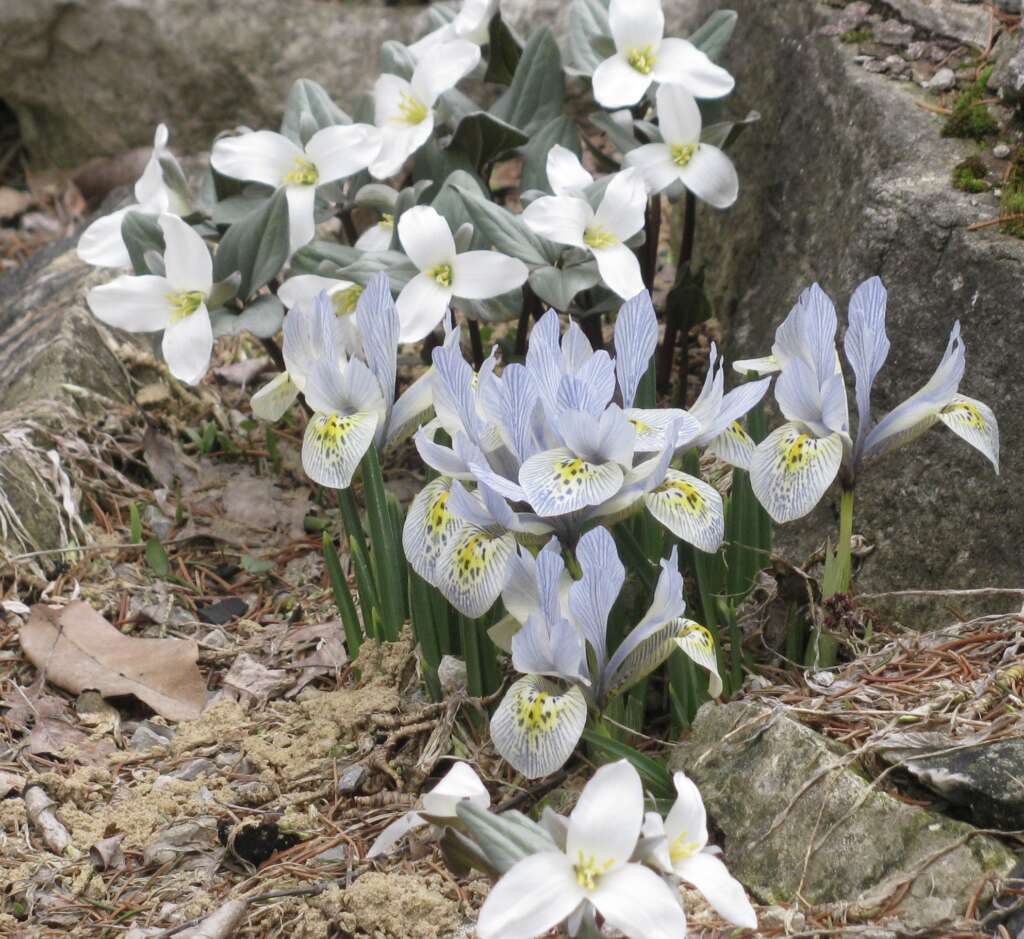
In our garden, the cool (if not cold) early Spring weather seems to be the domain of the “little bulbs”. Cyclamen coum, Eranthis, Galanthus, in addition the the early bulbous irises (histories and reticulata) all command the opening of the Spring Gardening Season.

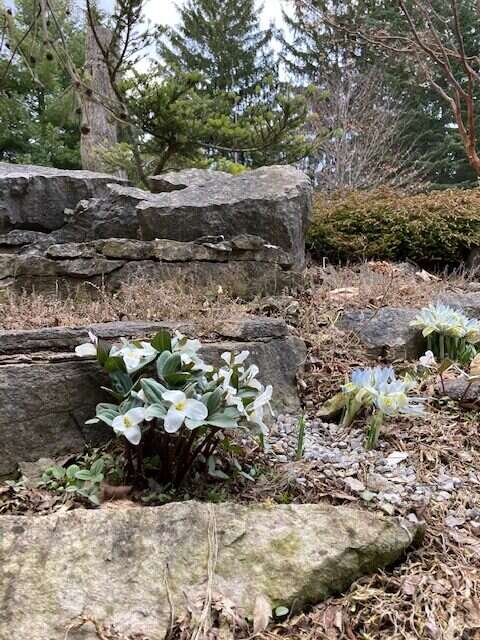
However, there is a little vignette in this garden that never fails to captivate my attention, not so much for it’s well planned construction (because it wasn’t), but instead for the serendipitous success of the plants sited therein.

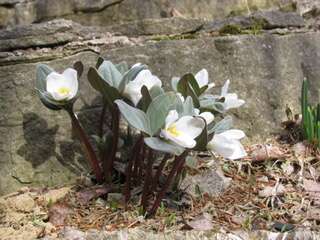
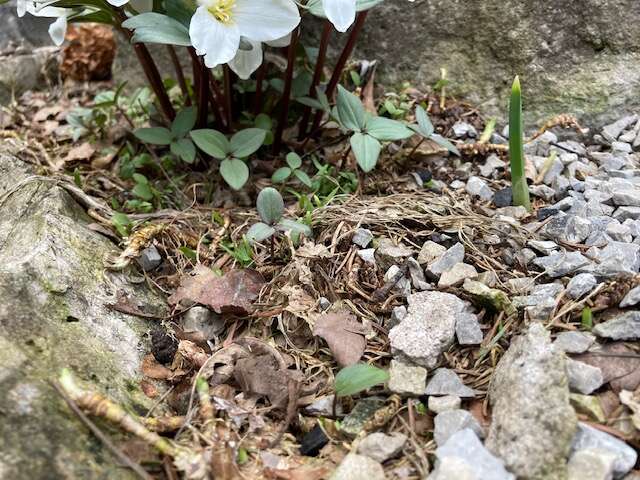
The star of this little corner is Trillium nivale, commonly referred to as the snow trillium. This minute Trillium makes its appearance in the garden, along with last of the Eranthis blooms, as well as Galanthus nivale.

Most years this petite trillium is joined by Corydalis and Iris histroides ‘Katherine Hodgekins’. This unplanned pairing never fails to delight me. The fact that these little treasures thrive here has more to do blind luck than any forethought to this particular bed’s construction. The area of lawn that preceded this site was first covered over, first with sections of wet newspaper, the edges overlapping each other by roughly 20%, and then I covered the newsprint with the day’s grass clippings, until I could bring home a load of wood chips that were then applied in a 6-8″ thick layer. It was an effective method for killing the grass & weeds without resorting to a chemical application.

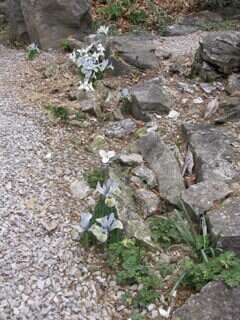
Later on when I decided to construct the Limestone Bed here, I simply hauled in the large chunks of limestone from a local quarry, backfilled between the larger rocks with coarse sand, and mulched everything with crushed limestone gravel. For the paths in and around this bed I utilized the same crushed limestone gravel 5-6″ in depth.

My first encounter with Trillium nivale, was in the magical garden of Roberta & Fred Case, known for their extensive collection of Trillium. It was by no means my first visit to this special place, though it was the first time I was there early enough to experience this earliest flowering of the trillium species.

I noticed that these diminutive gems were growing at the base of a low, broken ridge, made up of Limestone rocks. I don’t recall if the word calciphile was used, but it was made plain that a higher alkalinity it what they really desired.

It was sometime before I was able to attain my first plant of T. nivale (which happened to be the Indiana Form ), at a Great Lakes Chapter Spring Plant Sale. The Indiana form sports larger blooms than does our native Michigan Snow Trillium.

I thought I had a suitable spot (though it was technically in the edge of a path) and the medium was basically just crushed limestone gravel, so I worked in a bit of my heavy loam soil before planting, as well as into the gravel I used to backfill my new prize. Little did I realize how fortuitous was the site I chose.

That plant bulked up quickly, allowing me to divide it on several occasions. Clearly delighted in it’s new home.

Several years later, a fellow GLC member imported a goodly number of new T. nivale plants from Indiana and I acquired several. The following spring I cross pollenated them all by hand. (Obviously I failed to capture all of the seed that was set).

Only in hindsight do I realize the unique conditions of this site which enables such success. For they hold far more importance than simply the limestone.

Over time the continuous activity of ants and worms had transported the heavy clay-loam soil (enriched by the heavy application of now decomposed wood chips), which underlays all of my beds, and throughly infused it within the limestone gravel.

Another factor is the ridge of Limestone which backs them has a SW exposure. At this time of year the spot is bathed in hours of afternoon sun. In combination with exposure is an Amelanchier canadensis (the first tree I planted), located to the WSW (on the opposite side of the path), now leafless, but in a couple of weeks it will leaf out and offer relief from the hot sun of late spring and summer.

It’s been a happy accident and I didn’t think that I could be more pleased.

Then four years ago something quite new appeared. Among the stems of the largest clump of T. nivale, was one that had a bloom made up of four petals rather than the usual three. When I examined that stem further, I noticed that the leaf contained a complement of four leaflets as well. Now this is not unheard of, and while oddly intriguing, this anomaly is rarely stable (as I was often reminded). As the size of that clump had gotten quite large I decided to remove a division which comprised nearly 1/2 of the clump, but I left the half containing the 4 x 4 stem in place.

The following year the 4 x4 stem reappeared, looking as healthy as all of its sister stems in the clump. I made mention of this, and was reminded of its dubious stability, as the blooms opened, the four petaled bloom was there, and returned once more in the Spring of 2020, that made three years running!

Then last year this happened. Yep that’s a second four petaled flower with its full complement of four leaflets. Now that’s enough to make one sit up and take notice! What would next year bring? Well…

The short answer is a third 4 x 4 stem, but wait there is also another odd stem, and this one has a five petalled bloom and five leaflets!!!

Now I don’t know where this is going to lead, but for the past week I’ve been cross-pollenating the 4 and 5 petalled blooms with each other. If these unusual stems are offset from the same clump and not one of many seedlings, then they may not be self compatible (hence no seed). It has been so cold and dreary nearly all week I haven’t seen a single pollinator anywhere in the garden, so who knows. All I can say is I’m keeping my fingers crossed.

Now, about dividing this clump again…